Why you need both a designer and a contractor
One of them decides what gets built. The other builds it. Collapsing the two is where budgets go.
September 1, 2026 · 3 min read
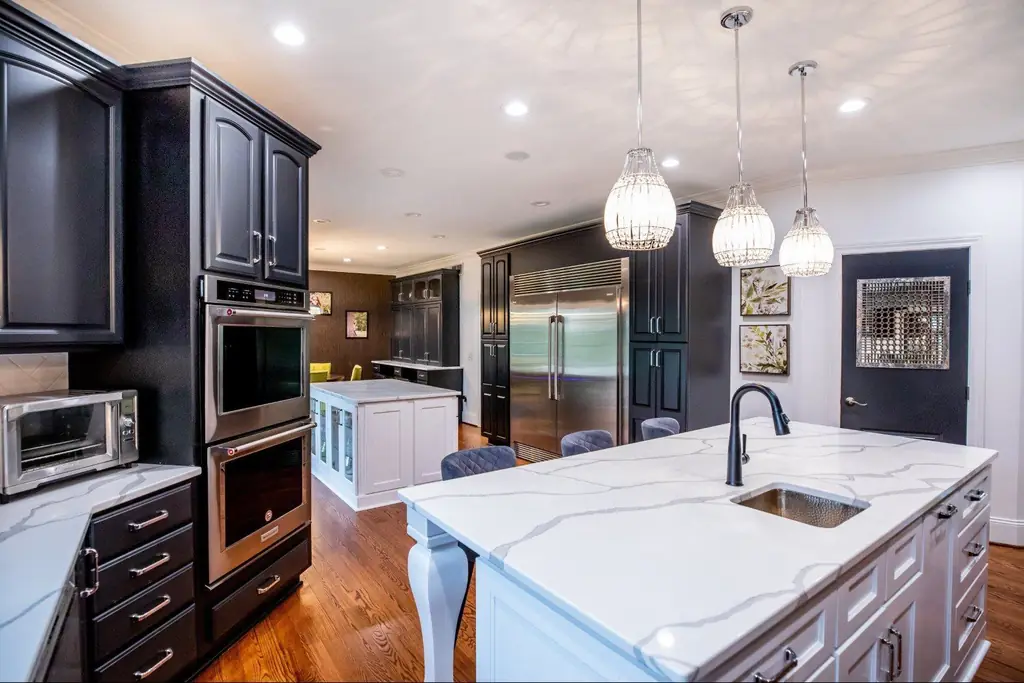
It is a fair question. You are already paying a contractor, the contractor has done a hundred kitchens, and the contractor is happy to tell you where the island should go. Why add a designer to that?
Because they are not the same job, and only one of them is reversible. A contractor is responsible for building what has been decided, well and safely. A designer is responsible for the deciding. That includes the layout, the clearances, the storage strategy, the lighting, and the finish selections that have to work together across the room. Those decisions are cheap while they are still lines. They become expensive at exactly the moment the first cabinet is fixed to a wall.
What the designer is actually doing
Full service design covers more ground than most people expect. Paula Kinney's own description of it is selecting paint colours, flooring and countertops, and planning and renovating the entire space. In practice that means someone is holding the whole room in their head at once: how the cabinetry meets the ceiling, how the flooring meets the adjoining room, whether the countertop and the backsplash are fighting each other, and whether the light over the island is at a height that will not sit in your eyeline while you eat.
- Layout and clearances, resolved before anything is ordered
- Storage designed against how the household actually cooks and stores
- Appliance placement and the door swings that follow from it
- Lighting: ceiling, under cabinet, and task light where the work happens
- Finish selections chosen as a set rather than one at a time in different showrooms
What the contractor is actually doing
Everything that is physically difficult and legally consequential. Structure, services, sequencing, trades, and making the built room match the drawing. A good contractor is worth a great deal, and their time is best spent on that rather than on redesigning your room from a stepladder while three other jobs wait.
The relationship works best when the drawing is complete enough that the contractor can price it accurately and then build it without interpreting it. That is the practical test of whether a plan is finished: can somebody who has never met you quote from it, and would two different builders arrive at the same room?
What goes wrong when the design step is skipped
Usually not a disaster. Usually a series of small compromises that nobody notices individually. A cabinet run stops six inches short of the wall and gets a filler panel. The pantry ends up on the wrong side of the room from the fridge. The island is the size the delivered slab happened to be. None of it is a mistake exactly, and all of it together is a kitchen that feels like it was assembled rather than designed.
The other common failure is spending. Without a plan you end up shopping for parts, which means visiting store after store, holding samples up against each other, and making decisions in the order the showrooms present them rather than the order the room needs. That is where both the time and the money leak away, and it is a genuinely miserable way to spend six weekends.
The order that works
Design first, then price, then build. The design establishes what the room is. The pricing tells you what that costs and where to adjust, and adjusting on paper is free. The build happens once, against a document, with a contractor who knows exactly what they are quoting for. It is not a longer process than the alternative. It is the same process with the arguing moved to the cheap end.
Love Your Nest sits firmly on the design side of that line and says so. Paula designs and specifies, your contractor builds, and the drawing is what keeps the two of you working from the same measurements. If you already have a builder you like, that is an advantage rather than a complication.
If you are weighing this up, the fifteen minute discovery call is the cheapest way to find out which parts of the project actually need a designer and which you can handle yourself. It costs nothing and it ends with a straight answer.
Love Your Nest Interiors — (800) 248-1173
Call (800) 248-1173